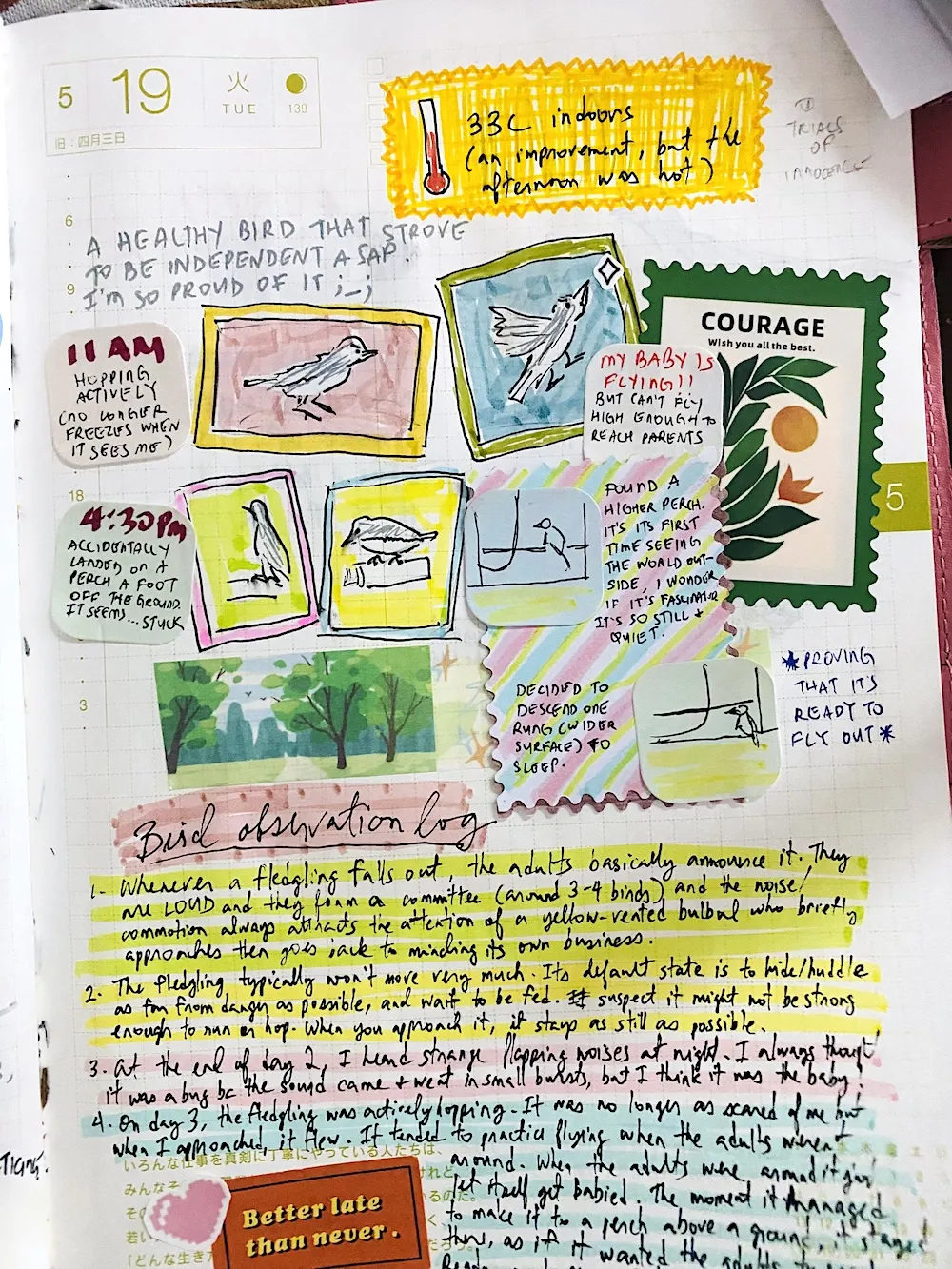
Bird observation log
Observation log of a baby sparrow that fell off the nest on a rainy day.
You can always tell when a baby sparrow has fallen off the nest because the adults are very loud about it. They form a committee and chirp urgently—maybe among each other, maybe at the stranded baby—and the commotion always attracts the attention of a nearby yellow-vented bulbul who briefly flies up to check out the hullabaloo then, finding it uninteresting, goes back to foraging. (I've seen this happen twice!!!)
The fledgling typically won't move very much. Its default state when the adults aren't around is to huddle as far from the open space as possible with its back to danger. When it's hungry it meeps plaintively and waits for an adult to bring food. When a potential predator (for example me) approaches, it stays completely still, as if inanimate.
Baby sparrows are gray/brown, not having grown out all their feathers yet. The really young ones are darker, grayer, and fuzzier, and their legs are a lot less developed so they tip forward, always seeming one second away from face-planting, which is kind of hilarious. The one from this weekend seemed a bit more mature. Its coloring was a desaturated version of the adults' (an in-between grayish brown color with a noticeably lighter belly) and its proportions were very juvenile, skinny and lanky (as opposed to round and fluffy) and under-feathered. It gave the impression of being barefaced, lacking the black markings around the eyes and mouth.
On day 2, I heard a curious noise at night, like the beating of wings. It's not a new sound. I just always assumed it was some kind of bug (like a beetle or a cockroach) since the sound came and went in short bursts. But now I think it might have been the sound of fledglings practicing flight in the cover of night.
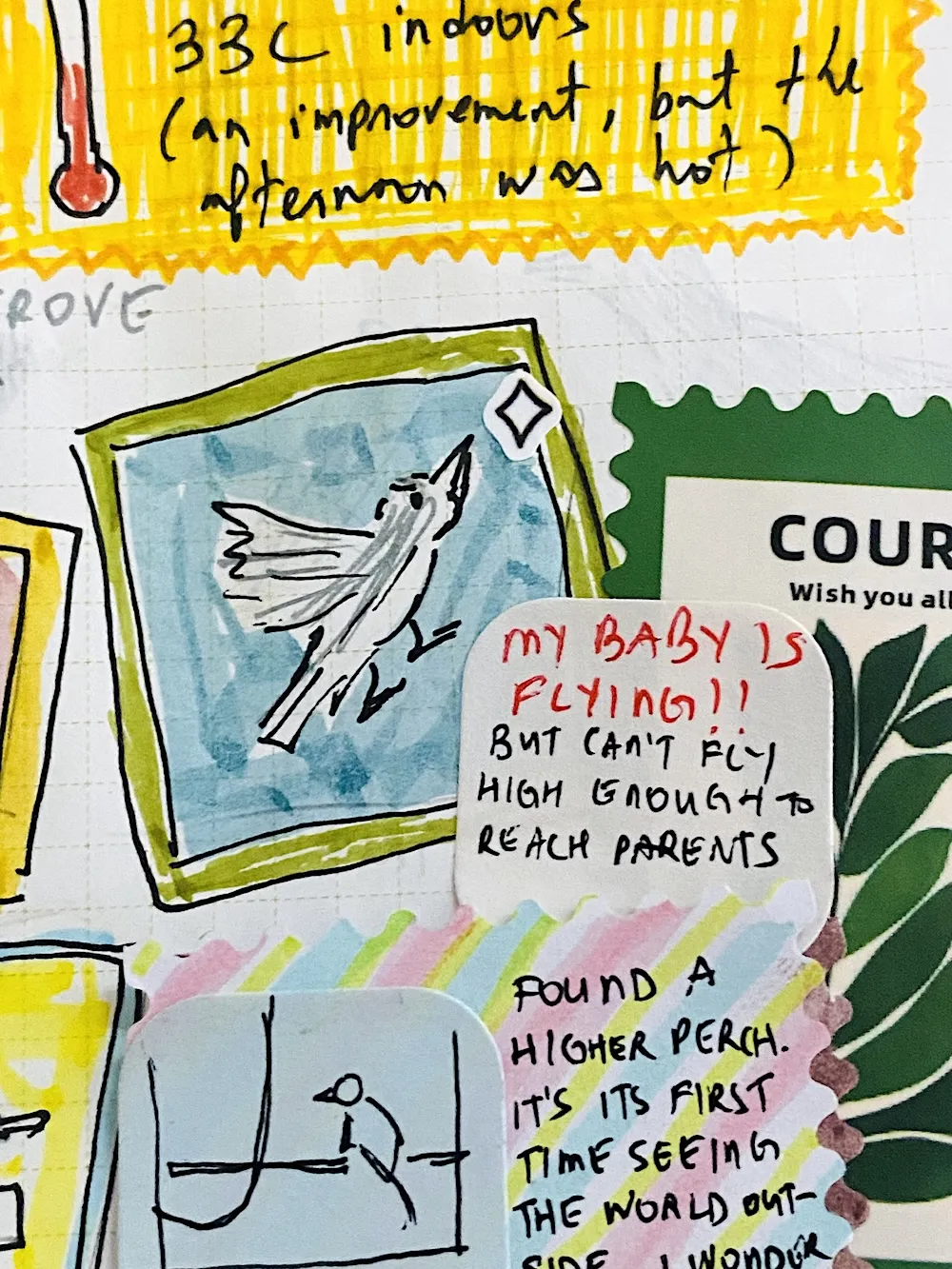
On day 3, the fledgling was hopping around actively. It no longer stayed still when I approached, either ignoring me or gliding away with its newly learned flying ability. It tended to practice flying when the adults weren't around, impatient to be independent and out in the real world. I imagine it felt more free to try new things when it was alone. (When the adults were around it just allowed itself to be babied.) It seemed very determined to get back to its parents and be taken seriously as an adult. The moment it managed to land on a perch above the ground, it stayed there, as if it wanted everyone to see that it was no longer grounded, that it was ready to contribute to society.
The first time it got on a perch high enough to get its first full, unobstructed view of the streets, it spent a long time just staring out. I wonder if it was entranced by the vastness of the world—the real world that its parents flew in and out of. It did not want to get back on the ground after days of being stranded there. It merely dropped to a lower perch, one it could stand more comfortably on, to sleep. I knew it would fly off the next day, but worried that its wings weren't strong enough yet.
On day 5, the fledgling was gone by the time I woke.